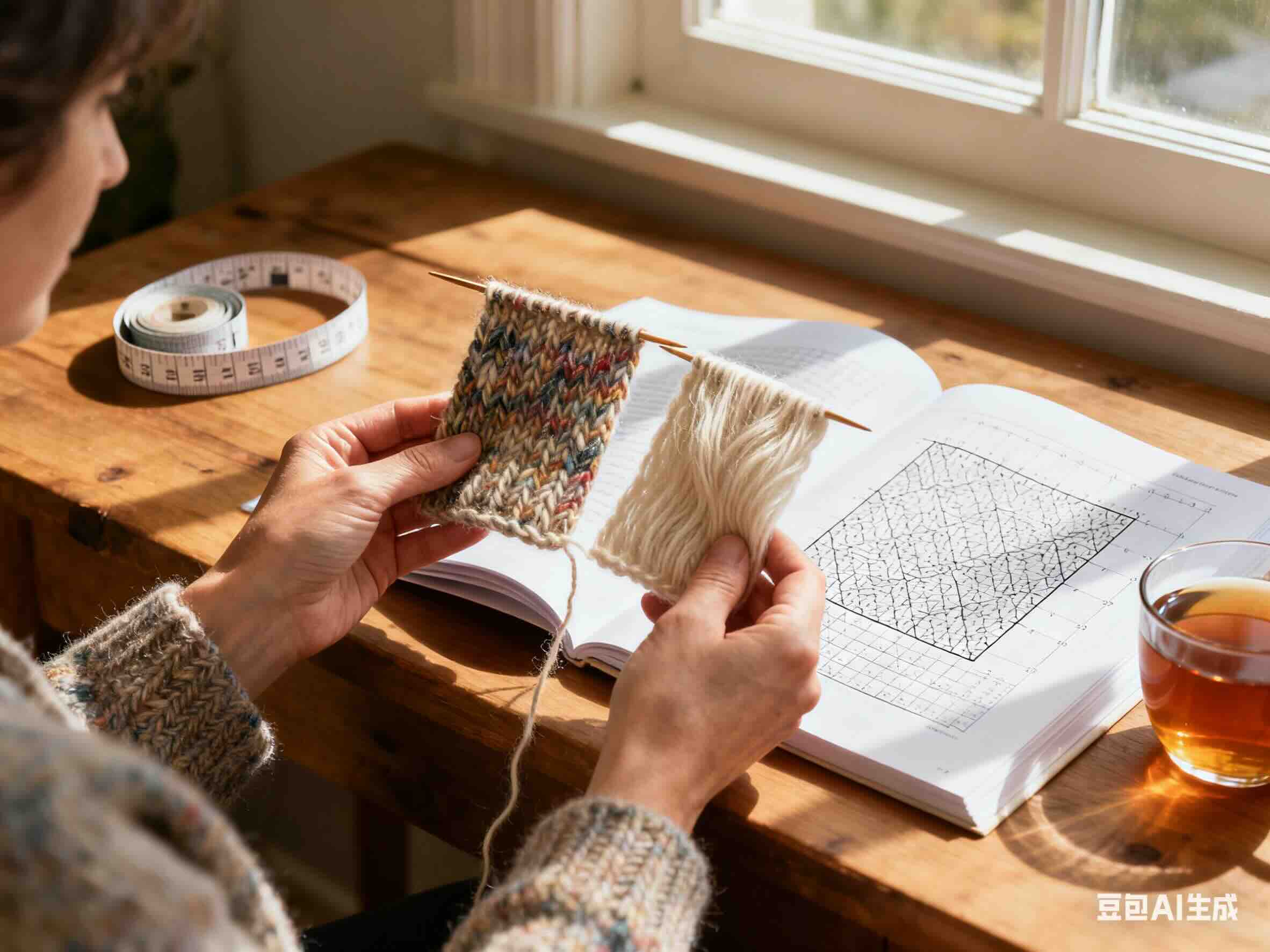
Every knitter knows the feeling. You find the perfect pattern, but the recommended yarn is discontinued, out of your budget, or a fiber you just don’t enjoy. Your heart sinks. Do you abandon the project? Absolutely not.
My name is Sarah, and for over two decades, I’ve been navigating the beautiful, complex world of yarn. I’ve learned that yarn substitution isn’t a dark art; it’s a skill. It’s about turning a potential roadblock into a creative opportunity. In this guide, I’m going to share my most trusted secrets for choosing the perfect substitute yarn, ensuring your finished project is not just beautiful, but successful in its structure, drape, and feel.
Why It's More Than Just Matching Colors
The original designer chose their yarn for a reason. A cabled sweater needs a springy, round yarn for stitch definition. A summer shawl calls for something with beautiful drape. Simply grabbing another skein of the same color and weight might give you a sweater that fits, but it might not have the life or character the designer intended. Our goal is to become knitting detectives, examining the evidence to find a substitute that honors the pattern’s design.
The Three Key Checks for Yarn Substitution
Over my 20 years of knitting and designing, I’ve distilled the substitution process down to three core checks. If you can master these, you can substitute with confidence.
| Check | Why It Matters | Your Action |
|---|---|---|
| 1. Gauge | The foundation of fit. If your gauge is off, your garment won't be the right size. | Knit, wash, and block a 6x6 inch swatch. |
| 2. Yarn Weight | Determines the thickness and density of the fabric. | Compare the yardage-per-gram ratio. |
| 3. Fiber Content | Dictates the fabric's personality: drape, warmth, memory, and feel. | Choose a fiber that does the same "job" as the original. |
Check #1: Gauge is Non-Negotiable
If you take only one thing away from this guide, let it be this: gauge is not optional. A pattern is a set of mathematical instructions based on a specific gauge. Even a small difference can have a massive impact. For a sweater with a 40-inch bust and a gauge of 5 stitches per inch, you need 200 stitches. If your gauge is off by just half a stitch—5.5 stitches per inch—those same 200 stitches will result in a bust of only 36.4 inches.
Your Action Plan: The Swatch Test
- Knit a Generous Swatch: Aim for at least a 6x6 inch swatch in the recommended stitch pattern.
- Wash and Block Your Swatch: This is a non-negotiable step! You must treat your swatch exactly how you plan to treat your finished garment.
- Measure Carefully: Once dry, lay your swatch flat and use a rigid ruler to count the stitches and rows in the central 4 inches.
If your gauge doesn’t match, change your needle size. If that doesn't work, it’s a sign the yarn isn't a suitable substitute. For complex conversions, our Knitting Gauge Converter can be an invaluable tool.
Check #2: Decode the Yarn Weight
Yarn weight (Fingering, DK, Worsted, etc.) is a good starting point, but these categories are broad. To be more precise, look at the yardage per gram on the yarn label (e.g., 220 yards / 100g). This ratio is a powerful indicator of density and thickness and is a more accurate guide than the weight category alone. A detailed Yarn Weight Chart is an essential resource for every knitter’s toolkit.
Check #3: Understand the Fiber's Job
This is where the artistry comes in. The fiber content dictates the fabric’s personality. The key question to ask is: What job was the original fiber doing? Was it providing structure? Drape? Warmth? Stitch definition? Try to choose a substitute fiber that can perform the same job.
- Wool: Elastic and resilient, perfect for cables and structure.
- Alpaca: Soft and warm with heavy drape, but can stretch out over time. Great for shawls.
- Cotton & Linen: Cool and crisp with no elasticity. Ideal for summer tops.
- Silk: Adds sheen, strength, and drape.
- Acrylic & Synthetics: Durable, machine-washable, and affordable. Great for kids' clothes.
Advanced Tips from a Pro Knitter
Once you’re comfortable with the three main checks, you can refine your choices even further.
Yarn Construction: Plied vs. Singles
Look closely at the yarn strand. Is it a single, gently twisted strand ("single"), or is it made of multiple strands twisted together ("plied")? Plied yarns are generally stronger, more stable, and create crisp, defined stitches for cables and lace. Singles have a softer, more rustic look but may be less durable.
Calculating Yardage: Don't Play "Yarn Chicken"
A 100g skein of lofty wool will have significantly more yardage than a dense 100g skein of cotton. Always buy yarn based on the total yardage required, not the number of skeins. The pattern will state something like, "1200 yards of worsted weight yarn." This is your target number. When in doubt, our Yarn Amount Estimator can help you get a solid baseline.
A Practical Walkthrough: Substituting for a Sweater
Let's put it all together. A pattern calls for a worsted weight, 100% Merino wool yarn (210 yds/100g) with a gauge of 20 sts / 4 inches. You need 1300 yards.
- Analyze the Original: It’s a standard worsted wool, chosen for softness and stitch definition.
- Find Candidates: You find a beautiful 80/20 wool/nylon blend (240 yds/100g). It's slightly thinner, but close.
- Swatch: You knit a swatch. US 7 needles get you 21 sts / 4 inches. You try US 6 needles and—bingo—20 sts / 4 inches. The fabric feels great. You wash and block it; the gauge holds. It's a viable substitute!
- Calculate Yardage: The pattern needs 1300 yards. Your substitute has 240 yards per skein. 1300 / 240 = 5.41. You know you must purchase 6 skeins to be safe.
Final Thoughts: Your Journey to Substitution Mastery
Yarn substitution is one of the most empowering skills a knitter can develop. It opens up a universe of possibilities, allowing you to tailor any project to your unique style, budget, and stash. Don’t be afraid to experiment. Your swatches are your laboratory. Remember the three key checks—Gauge, Weight, and Fiber—and use the tools available to you to make informed decisions. With every substitution you make, your intuition will grow stronger. So go ahead, fall in love with that pattern, and embrace the creative joy of making it uniquely yours.