Let's address the elephant in the room: most knitters hate making gauge swatches. Getting excited about a new project and immediately casting on the sweater pieces is incredibly tempting. But here's the unavoidable truth that experienced knitters know: skipping the gauge swatch is the surest way to project failure.
🚨 The Heartbreak Reality
Without knowing your exact gauge, your dream sweater could easily end up:
- Too small to fit over your head.
- So large the armholes sag to your waist.
- Densely stiff like armor, or loose like a fishnet.
- Consuming 30% more yarn than estimated.
A 30-minute gauge swatch can save you 30+ hours of frustration.
What Gauge Actually Controls
Needle sizes on yarn labels are just suggestions. Every knitter's tension is entirely unique. Your gauge (stitches and rows per inch) dictates four vital outcomes:
Size & Fit
Every dimensional measurement in your pattern mathematically relies on precise stitch density.
Yarn Usage
Knitting tighter means more stitches per inch, drastically increasing total yardage consumed.
Fabric Structure
Gauge controls drape and stiffness. Too tight breeds stiffness; too loose breeds drooping.
Project Timeline
A tighter gauge equals thousands more stitches to execute across a large blanket or sweater.
How to Knit the Perfect Gauge Swatch
Don't just cast on 10 stitches and call it a day. The scientific approach ensures you never waste yarn. Follow these ordered steps to lock in your exact numbers.
Make It Large Enough
Cast on at least 30 to 40 stitches and knit for at least 6 inches (15cm) high.
Edge stitches distort the fabric. A microscopic 4x4 inch square won't provide a reliable 4-inch inner span to measure. Always build a generous margin.
Pro Tip: Cast on an odd number of stitches and knit the first and last 3 stitches of every row in Garter stitch to prevent massive curling on stockinette.
Use the Exact Project Stitch Pattern
Replicate the pattern explicitly. If your sweater body is heavy cables, your swatch must be cabled. If it's ribbing, swatch ribbing.
Different stitch architectures pull varying amounts of yarn. Cables dramatically contract fabric width, while lace wildly expands it. A stockinette swatch is utterly useless for a cabled cardigan!
Knit in Your Natural Rhythm
Don't knit more carefully than usual. Use your standard speed and posture.
If you're stiff and overly cautious while swatching, but plan to mindlessly knit the garment while watching TV or chatting, your baseline tension will be vastly different. Emulate your actual working rhythm.
The Critical Step: Wash and Block
This is where 80% of knitters fail. Unblocked gauge is a liar. You must wash and block the swatch precisely as you will treat the final masterpiece.
💦 Why Blocking Changes Everything
- Animal Fibers (Wool, Alpaca): The cuticles relax and "bloom", filling gaps. The gauge can morph by 10-20%.
- Plant Fibers (Cotton, Linen): Highly suspect to stretching when wet, contracting fiercely when machine dried.
- Synthetics (Acrylic): Heat-sensitive. "Killing" acrylic with steam locks the stitches permanently, changing the entire drape.
Measure Like a Pro
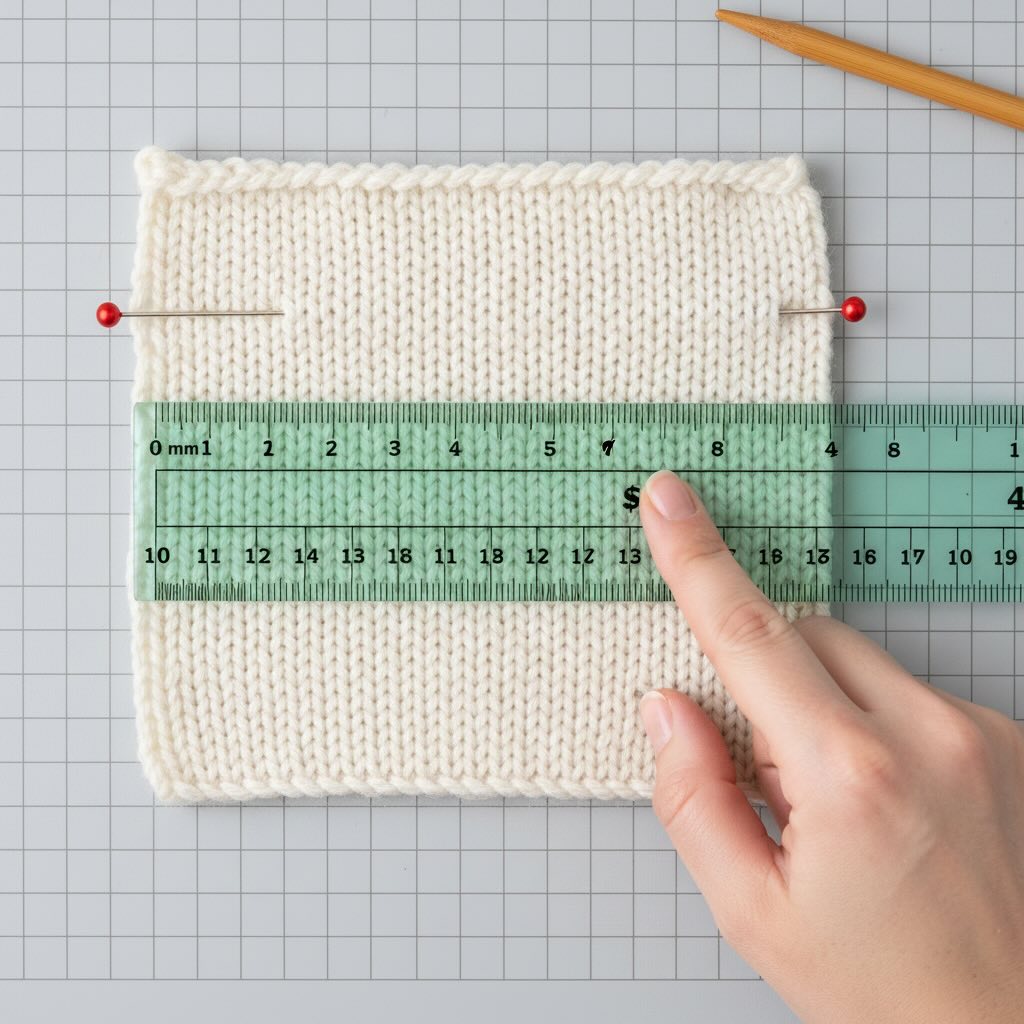
Lay the blocked, fully dried swatch flat. Use a rigid ruler. Avoid soft tape measures which stretch over time.
📐 Pro Measuring Tips
Place pins exactly 4 inches (10cm) apart across the center. Count every "V" between them. Do not round up or down! Count half and quarter stitches meticulously (e.g., 21.5 stitches). Measure in 3 different locations and average the math.
When Your Gauge Doesn't Match: The Fix-It Guide
Hitting the precise gauge printed on a pattern on your first try is rare. Here is exactly how to course-correct without panic.
Scenario 1: You Have Too Many Stitches
The Problem (Too Tight)
Pattern requires 18 sts per 4". You measured 22 stitches.
Your fabric is overly dense and small. A 40" sweater will knit up as a 32" straightjacket.
The Solution
Action: Go UP needle sizes.
Larger needles generate fatter, wider stitches. Re-swatch using a needle 1 or 2 sizes larger until you hit the 18 count.
Scenario 2: You Have Too Few Stitches
The Problem (Too Loose)
Pattern requires 20 sts per 4". You measured 16 stitches.
Your fabric is baggy, prone to snagging, and overly massive. A fitted hat will flop over your eyes.
The Solution
Action: Go DOWN needle sizes.
Smaller needles create tighter, narrower stitches. Grab a smaller needle and try again.
Scenario 3: The Drape is Terrible
The Problem (Bad Fabric)
You hit the target gauge perfectly, but the resulting fabric feels like cardboard, or it's so sheer you can see through it.
The Ultimate Solution -> Recalculate!
Find the needle size that produces the exact drape/fabric you actually want. Then, use our robust Gauge Adjustment Calculator to mathematically rewrite the pattern's stitch counts to match your newly minted, perfect-feeling gauge.
Advanced EEAT: The Science of Fiber Memory
Expert gauge management requires deep knowledge of Fiber Memory. Fiber memory refers to a yarn's intrinsic ability to stretch and actively snap back to its original spun dimension.
Wool and Animal Fibers: Extracted from keratin-based hair, wool operates like a micro-spring. It boasts exceptional fiber memory. When wetted and blocked, the scales open (blooming), but as it dries, the core snaps back, ensuring garment structure remains remarkably stable over years of wear. Your blocked swatch gauge for wool is exceptionally reliable.
Cotton, Linen, and Plant Fibers: Based on cellulose, these are stiff, inelastic fibers with absolutely zero memory. When knit heavily, cotton garments will permanently stretch downwards under their own gravitational weight. A cotton sweater swatch might hit 18 sts/4" initially, but expand over a day of wear. Experienced knitters counteract this lack of memory by knitting plant fibers slightly tighter than pattern gauge, relying on the inevitable sag to achieve the final dimension.
Synthetics (Acrylic): Extruded plastics have high molecular stability until exposed to heat. Acrylic won't naturally block via just water. It requires gentle steam to relax. However, apply too much heat and the plastic fibers permanently melt and fuse—destroying tension entirely.
Stop Guessing. Start Knitting with Confidence.
Now that you've mastered the logic behind gauge, it's time to leverage the right math. If your swatch is off, don't abandon the beautiful yarn you just bought. Adapt the pattern instead.
Calculate Your Exact Pattern Adjustments